
Categories
Uncategorized

Baldwin Takes Helm of Kensington Fire Safe as Group Expands Wildfire Preparedness Efforts

KENSINGTON, CA — September 27, 2026 — Kensington Fire Safe Council has named Mike Baldwin as its new president, bringing a longtime business leader with more than 35 years of private-sector experience to the community’s efforts to help prevent and prepare for wildfire.

Baldwin joined the Board of KFSC about two years ago and quickly took over running the semi-annual Dumpathons, which have removed over 50 tons of green waste/wildfire fuel annually.  He has also led an effort to secure FireWise recognition for 61 Kensington homes, providing them greater fire resilience and potential fire insurance discounts.

Baldwin and his wife, Sheri, moved to San Diego in 2024. Since then, Baldwin has become increasingly involved with the community, including overseeing Kensington Litter Pickers and serving on the board of Kensington Community Association, as well as supporting a range of other projects.

As president, Baldwin says his priority will be building the organizational infrastructure needed to sustain and expand KFS’s work for years to come.

“Kensington has an extraordinary group of volunteers who care deeply about protecting our community,” Baldwin said. “My goal is to help build the structure, systems and long-term capacity that will allow Kensington Fire Safe to continue and expand our wildfire mitigation work for many years to come.”

Baldwin brings extensive experience in building and leading organizations. He has served, and continues to serve, on the boards of several industrial services companies and is the founder of Briarwood Partners, an independent sponsor-model private equity firm.

Over more than three decades in the private sector, Baldwin has worked closely with management teams to build and operate companies, expand market share in highly competitive industries, manage labor and management relationships, and develop customer-focused corporate cultures.

That experience will now be applied to a very different kind of organization: a community of volunteers working to reduce wildfire risk.

“KFS has accomplished a tremendous amount because of the commitment of its volunteers,” Baldwin said. “I’m very proud to have the opportunity now, to build on that foundation and ensure the organization is strong and sustainable for the future.”

Baldwin’s appointment comes as Kensington Fire Safe continues to expand its community wildfire-preparedness efforts, including public education, neighborhood projects, vegetation management and other measures designed to reduce wildfire risk and improve community resilience.

Baldwin and Sheri have been married for 40 years and have two grown sons and one granddaughter. They enjoy traveling and experiencing other cultures, traditions and food. Baldwin is also an avid backpacker, woodworker and golfer.

About Kensington Fire Safe

Kensington Fire Safe is a community-based organization working to reduce wildfire risk and strengthen the preparedness and resilience of Kensington and surrounding communities. The organization relies heavily on community volunteers and works on wildfire education, preparedness, vegetation management, home-hardening awareness and other fire-safety initiatives.

Media Contact:
Kensington Fire Safe
info@kensingtonfiresafe.org

###

About Kensington Fire Safe (KFS)

For 25 years, KFS volunteers have organized projects to make Kensington safer from wildfires for its residents and businesses. More info at  kensingtonfiresafe.org
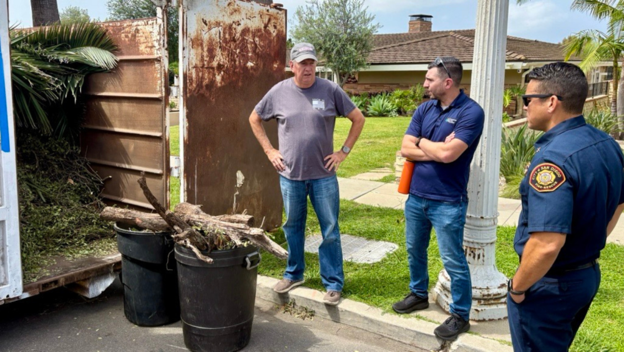
Dumpathon organizer Mike Baldwin reports Spring 2026 Dumpathon success to officials Franklin Coopersmith, Deputy Director, SD Environmental Services Department and Assistant Fire Marshal, Alex Kane, Wildfire Program Manager  Photo Credit: Inside San Diego

2025 KPBS interviews KFS including Mike Baldwin: https://www.kpbs.org/news/environment/2025/01/21/kensington-residents-concerned-about-fire-risk-posed-by-illegal-encampments

Categories
Uncategorized

Are Home Inspectors Really Updated on Zone Zero?

Fire-ey Questions, Fall 2026

By Judy Harrington, Kensington Fire Safe (KFS)

Kensington’s Fire Safe Council will share researched answers to your inquiries. Send fire-related questions to info@kensingtonfiresafe.org.

Q #1  How can I get a home inspection by someone who definitely knows recently changed Zone Zero requirements?

We hear mixed stories about inspections and the new Zone Zero mandates for homes in Very High Fire Hazard Severity Zones (VHFHSZ) – maybe because rules have been evolving, particularly when it comes to vegetation.

However, City of San Diego Fire Rescue Home Risk Assessment inspectors are now well-trained. This is based on recent presentations they’ve made as well as feedback from neighbors who had inspections.  The cost is $163 and it covers defensible space, Zone Zero, ember resistance, and much more.  To request one —  at least two weeks in advance of your target date — complete the form at: https://forms.zohopublic.com/CRR/form/HRARequest/formperma/AAy75OpE1WSmMaJOPuYQNXOE8IaPgGQ654_PhfIJo9M

In addition, San Diego County Fire Safe Council recently expanded the eligible area for their assessment program to include Kensington!  It’s free and I had it done at my house – very helpful!  To apply go to; https://firesafesdcounty.org/hap/

Newly-Allowed Plants

Current California’s Board of Forestry and the city of San Diego rules appear to be more consistent and more lenient than previously expected regarding vegetation.  They now require no plants within:

  • ONE foot of a structure or the edge of eves, whichever is greater,
  • TWO feet of windows, doors, and vents, and
  • FIVE feet of adjacent features like decks. 

Check out these and other important specifics, particularly regarding trees, at https://www.sandiego.gov/sites/default/files/2026-04/zone-0-guidelines-for-existing-structures.pdf

Note that the rules are subject to change at the discretion of the city’s Fire Code Officials.

What About Fire-Blocking Vegetation?

We’re constantly hearing opinions about Zone Zero and how some plants are highly fire-resistant or may actually block embers from reaching your home.  These issues and other common questions are addressed, including the science behind the issue, in a well-done State Board of Forestry’s Q & A. It’s definitely worth a read before you make landscaping decisions. https://www.sandiego.gov/sites/default/files/2026-01/state-board-forestry-fire-protection-zone-0-faq.pdf

San Diego Fire Rescue wants existing VHFHSZ homeowners – virtually all of Kensington – to aim for compliance by February 2027 but have indicated they will focus on education rather than enforcement.

Of course, a big HOWEVER: the insurance industry may have the last word.

  • Their Institute for Business and Home Safety’s five-foot  Zone Zero requirement: “Remove all vegetation down to bare mineral soil, including grass, weeds, flowers, succulents, cacti, plants, shrubs, vines, and debris. No exceptions—even if irrigated or labeled fire-resistant.”  More details on page 10 of this document: https://wildfireprepared.org/wp-content/uploads/WFPH-Technical-Standard.pdf
  • To do your own inspection based on their rules: https://wildfireprepared.org/wp-content/uploads/WPH-How-To-Prepare-My-Home-Checklist.pdf

One neighbor reported she couldn’t get her insurance renewed unless she implemented Zone Zero. On the other hand, local insurance agent, Scott Caraveo, told us, “As of right now, none of the insurance companies I work with specifically require Zone Zero. A few offer small discounts for it, while others may consider a home for coverage if Zone Zero is already in place when it otherwise might not qualify.”  Contact scott@caraveoinsurance.com for more info.

Also:

Drum Role, please: KFS would like to announce a change in leadership!  Congratulations to Canterbury Drive resident Mike Baldwin who has been elected our new President. 

I have served in that role for five years and am happy to pass the baton onto this very capable and hard worker!. 

Mike has been organizing and overseeing our Dumpathons for a couple of years and recently successfully secured Firewise designation for about  60 area homes, making them safer and providing potential insurance discounts for those residents.  One of his top goals is to have all of Kensington achieve that designation – with new homeowners helping to lead the effort. Please contact us at info@kensingtonfiresafe.org if you’d like to help make that happen!

KFS Fall Dumpathon is October 20 – November 2nd. More info and dumpster locations will be posted on neighborhood signs, Nextdoor and our Facebook page. If you don’t already get our announcements, send your email address to info@kensingtonfiresafe.org and you’ll be notified by email.

Check out the new city rules for Zone Zero  before planning landscaping!

Categories
Uncategorized

Can Four-Legged Firefighters Make Canyons Safer?

Fire-ey Questions, Fall 2026

By Judy Harrington, Co-Chair, Kensington Fire Safe (KFS)

Kensington’s Fire Safe Council will share researched answers to your inquiries Send fire-related questions to info@kensingtonfiresafe.org

Q #1  Love seeing the goats clearing brush along the 8 freeway – wouldn’t that be great for our overgrown canyons?

We’re not saying, “Baaaaa” to a goats, but it might be challenging. Thanks to the work of Kensington resident Alina Talbott, we have a lot of info on the subject!

No kidding, goats can be a highly eco-friendly, targeted method of wildfire prevention, reducing invasive plant species, creating natural firebreaks, and best of all – reducing dangerous fuel loads without heavy machinery damaging hill sides, or toxic chemicals for animals and residents to breathe.

But here’s the kickers: tasks include herding some neighbors together to support the effort, obtaining access for City-owned parcels, protecting sensitive habitats, avoiding native plant species and other steps.  And then there’s annual maintenance.

An interested canyon neighborhood would need leadership to oversee the project and help raise donations, although partial or matching grants might be available.  One company estimated initial costs of over $80,000, then $23,000 for annual grazing maintenance.

If all that doesn’t get your goat and you’d like to explore using these in your area, let us know: info@kensingtonfiresafe.org.

Q #2  Any fire resistant paints we can use on our wood trim?

Short answer: yes, but…

When wildfire embers come calling, standard paint can panic – blister, burn, feed the fire and possibly release toxins. According to AI, specialized coatings can claim to be superheroes protecting the underneath surface to help a home survive longer when the heat is on, or at least buy valuable time before ignition.  There are several types:

  • Fire-retardant paints chemically reduce a surface’s ability to support combustion. Possible products include Firetect WT-102, Firecoat, and FlameOFF Fire Barrier Paint. Costs?  $75 – $95/gallon
  • Paint additives can be mixed into standard paints to improve fire resistance and, in some cases, achieve a Class A fire rating. $10 to $25 per 8 oz bottle, which treats one gallon of standard paint.  Common choices include Flamecheck M-111PA Paint Additive and Flame Stop III Additive.
  • Intumescent paints or coatings expand into a protective char layer when heated. This provides the highest level of life-saving structural protection but runs $75 to $150+ per gallon, or $350 to $550 for a 5-gallon pail. Additional installation costs can range from $10 to $30+ per square foot due to required thickness and professional application.   Some choices are Sherwin-Williams FIRETEX  for structural steel. Nullifire for steel, concrete, and Firefree 88

OK, here’s the “but.” According to the excellent Marin County FSC website, USDA research reported that “fire-retardant coatings have an uncertain “shelf life” when used in an exterior location and would therefore need to be reapplied regularly.”  Check out the full report at: https://firesafemarin.org/harden-your-home/coatings-and-gels

Finally – big thank you for a Historic Kensington Haul 25.37 tons of wildfire fuel is outta’ here thanks to Kensington volunteers — a new KFS Spring Dumpathon record. And, just a wee bit under our all-time high!

Kudos to (1) fab folks at SD Fire-Rescue and the City’s Environmental Services Dept. for initiating huge support this year, permits, safety barricades, dumpsters, and logistics, as well as hosting a wildfire preparedness workshop for 63 neighbors, and (2) a dozen dumpster hosts for monitoring their containers while District 9 Council Office supplied additional permits.

So now we’re all just a little safer…but best to heed experts and be ready when a wildfire does occur. Everything you need to know is in one place: https://www.sandiego.gov/…/com…/safety-tips/ready-set-go

Because of Kensington’s success, other San Diego fire safe councils are planning Dumpathons!

Categories
Uncategorized

Can Kensington get Firewise home insurance discounts?

Fire-ey Questions, Mar-Apr-May 2026

By Amy Dyson and Judy Harrington, Co-Chairs, Kensington Fire Safe (KFS)

Kensington’s Fire Safe Council will share researched answers to your inquiries Send fire-related questions to info@kensingtonfiresafe.org.

Q #1  I hear some Kensington blocks are going for a Firewise designation to get insurance discounts.  What is it and how do you get it?

Maybe. The National Fire Protection Association’s Firewise USA program recognizes homeowner fire safety efforts with a certification you can share with insurers. Some  20+ San Diego County communities have earned it and some in those areas said they received insurance discounts or rebates. In other instances, it may have avoided insurance cancellations.  The current California FAIR plan website specifically lists available Firewise discounts.

The best reason to go Firewise, however, is to reduce risk for your homes and our entire community.  Many of the requirements are steps Kensington Fire Safe has been taking for years, such as investing in fire safety education and efforts – like our semi-annual Dumpathons for brush management. 

One north Kensington area is currently investigating Firewise requirements and has an identified “Wise Guy” or project leader.  Besides having a leader, the group will also need to develop a three-year action plan and document their fire safety efforts. Kensington Fire Safe can help with these and many other requirements.

If you’ve ever wanted to do more to increase your block’s fire resilience, this is a concrete way to do it!  Check out the Firewise process, and if you want to consider kicking this off in your area, let us know. We’re happy to share our learnings: info@kensingtonfiresafe.org More info at: https://www.nfpa.org/education-and-research/wildfire/firewise-usa/become-a-firewise-usa-site

Q #2 Is KFS holding a Spring Dumpathon and can I get a dumpster in front of our home?

Yes, we are planning a May 5-18, 2026 Dumpathon!  Unfortunately, new requirements for dumpster events are quite challenging for Fire Safe Councils, but San Diego Fire Rescue is working very hard to resolve them.  We’re optimistic that we will be able to proceed!

If you would like to be a dumpster-minder, contact us at info@kensingtonfiresafe.org.  BTW, we’re going to prioritize dumpster locations for Kensington communities seeking Firewise certification.  For more information, check out our Q & A.

Q #3. Can I get tax credit for the double pane windows I installed to increase my home’s fire resistance?

Your 2025 window expenditures probably also helped save energy, and that may qualify you for clean energy tax credits this April 15th. Credits can equal up to 30% of qualified expenses, including energy efficiency improvements installed during the taxable year.  However, under the last budget bill, apparently some credits end December 31, 2025, with no 2026 extension for typical rooftop solar or home improvements.  To learn more, go to: https://www.irs.gov/credits-deductions/energy-efficient-home-improvement-credit

Q#4 Are trees allowed in the new Zone Zero?

Depends on who you ask.

 City website currently says…”Trees are allowed within Zone Zero as long as they are properly maintained and regularly pruned. Healthy branches must be kept at least five feet from roofs and exterior walls, and the tree canopy (drip line) at maturity must be maintained at least 10 feet from roofs and other structures.” https://www.sandiego.gov/fire/community-risk-reduction/defensible-space-property-owners

But your insurance company may use their research institute regs, which currently state:  “Remove all trees, limbs, and branches within or overhanging (looking vertically to the sky) the 0–5 Foot Noncombustible Zone”. https://wildfireprepared.org/wp-content/uploads/WPH-How-To-Prepare-My-Home-Checklist.pdf

JOIN US

 Earth Day, April 11th … and make some Zone Zero qualified cactus (while supplies last)!

With gravel in pots rather than the raffia pictured here.  We need lots of round, fairly smooth rocks!  Please let us know if you can help!

Categories
Uncategorized

What Exactly Are “Fire Ladders” ?

Fire-ey Questions, Sept-Oct-Nov 2025

By Amy Dyson and Judy Harrington, Co-Chairs, Kensington Fire Safe (KFS)

Kensington’s Fire Safe Council will share researched answers to your inquiries and over 85 questions posed at November’s Montezuma Fire forum. Send fire-related questions to info@kensingtonfiresafe.org.  

Q #1 Why are firefighters talking about “ladders” in our yards?

A:  Six homes destroyed in a recent Lakeview fire, 1,600 in L.A. last year…while we don’t know exactly how each ignited, recent fire safety articles and presentations have warned that “ladders” can be a major source of damage.  What are they?  Anything flammable that leads to your home.  Major culprits include wood fences that ignite easily bringing the flames closer to window frames, eves or other flammable parts of a home.

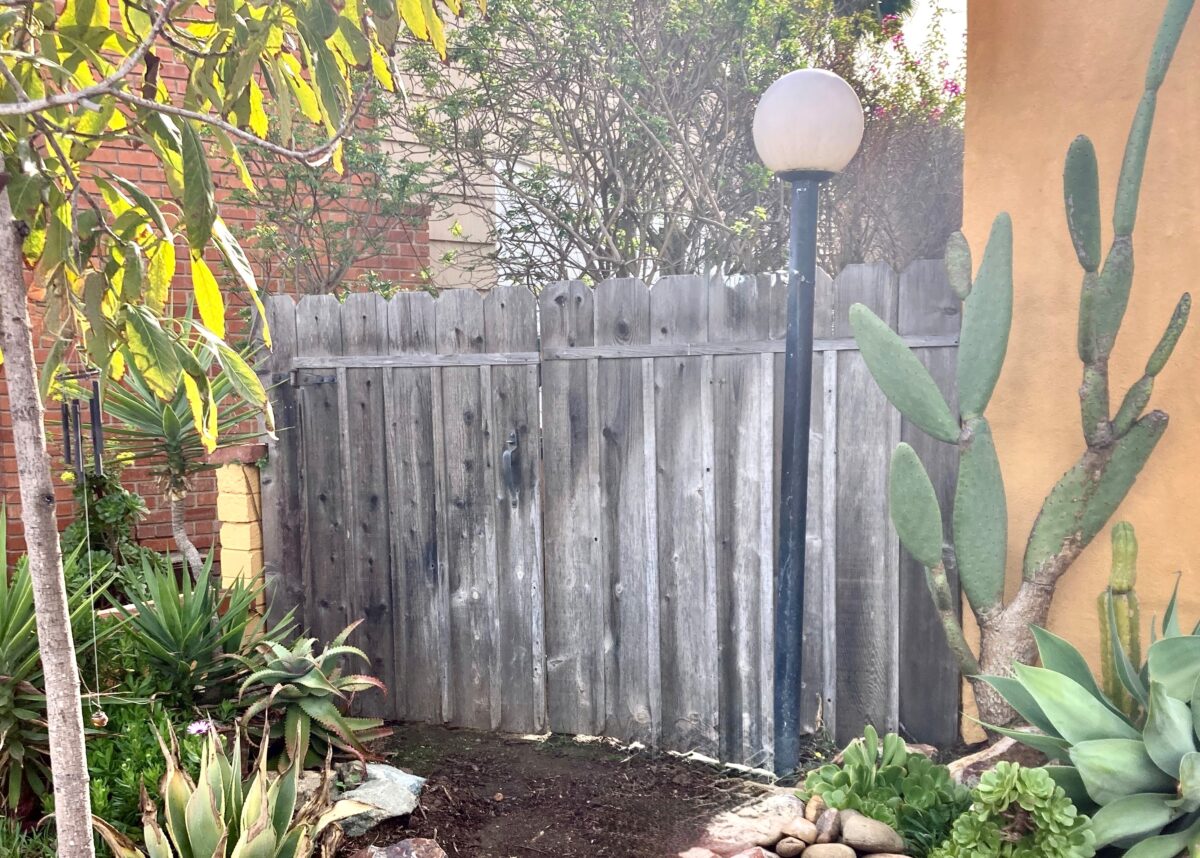
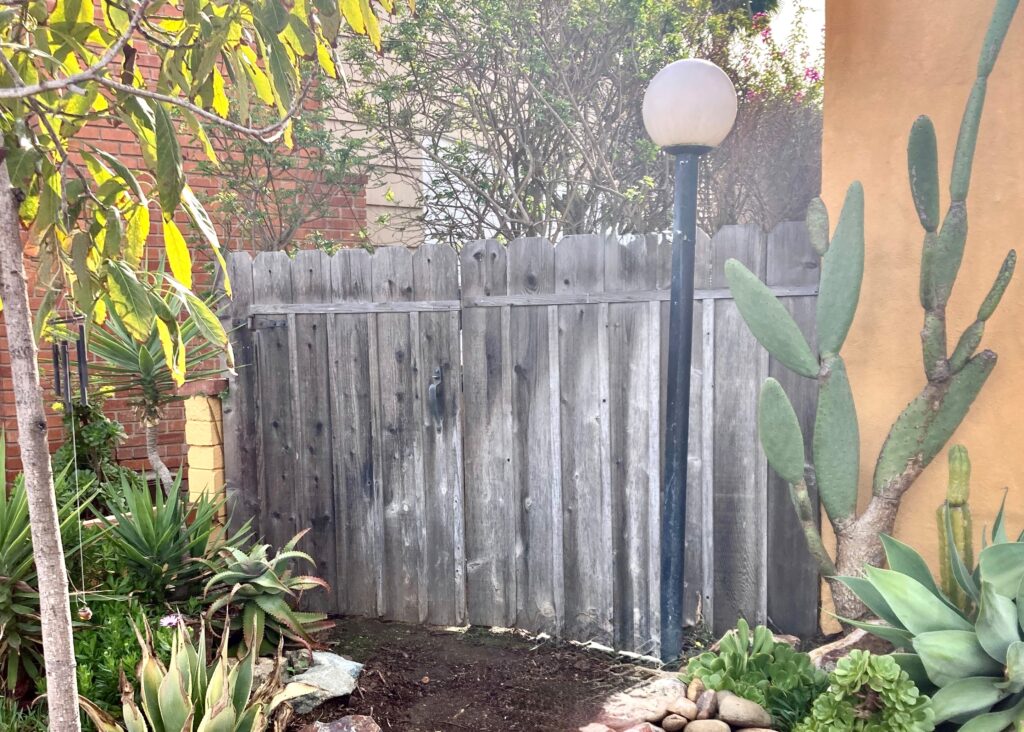
If this old fence ignited in a wildfire, it could bring flames to a wood window frame three feet away. Tree branches and other close plants could also be moved out of the five-foot zone zero next to the structure to increase fire safety.

Is vinyl fencing better than wood? It is supposed to be relatively fire-resistant and more difficult to ignite.  If it does ignite, it may burn slowly, releasing less heat than some other materials.  However, we’ve been told that burning vinyl could produce toxic fumes including hydrogen chloride which might spread the fire further and cause respiratory problems for residents and firefighters. Consider non-combustible materials like steel or wrought iron for your fence replacement. You could also investigate possible flame resistant-coating/primer at the link below. As always, do your own research!

Other possible ladders include flammable vegetation like tall grasses, shrubs and any tree branches that come within ten feet of a structure, allowing flames to climb up to your home.  This potentially lets a “ground fire” become a more destructive and rapidly spreading “crown fire.”  Solution? Prune back branches at least 10 feet from your home. Remove combustible plants, mulch and debris in “Zone Zero” – the first five feet from flammable structures.  Instead of wood mulch, consider hard scape such as pavers, concrete or rocks in this area.  Shredded redwood i.e. “gorilla hair” mulch has been reported as less flammable if you keep it well-irrigated with overhead watering, but how many of us are doing that with our water rates?

Two lists on Kensingtonfiresafe.org may help your efforts to reduce flammable yard growth: one lists landscape designers who completed a fire-resistant gardening course.  The second list includes Kensington-resident recommended gardeners and landscapers.

What else can I do if it’s inevitable that we’ll have a fire eventually?

One of our KFS members took part in “Home Inspection Zone” training that’s normally given to firefighters, and had some additional and very specific recommendations:

  1. 1/8” screening over eve, gable and ridge vents and any opening to crawl space or, check out Vulcan Vents which are supposed to close up when heated.
  2. Clean up roof, gutters and other sites of accumulated debris and leaves.  Where they’ve collected is where burning embers are likely to fall.  
  3. Weather strip exposed nooks and crannies
  4. In the event of a fire and possible evacuation:
    1. Move cushions, plastic or wooden patio furniture, door mats, umbrellas, trash cans, cars, RVs and anything else that’s flammable away from your home
  5. Close all windows and doors; leave outside lights on
  6. Turn off propane tanks
  7. Grab your pre-prepared list of who grabs what. You don’t want to spend precious time deciding that now.

And next month will be the anniversary of the Montezuma fire where we lost a house just across Fairmount Avenue in Alvardo Estates.  A good reminder that it can happen here!

Links to learn more:

CALFIRE’s wildfire safety steps:  https://readyforwildfire.org/prepare-for-wildfire/hardening-your-home/

Fire-resistant Fencing and Gates by Marin Fire Safe. https://firesafemarin.org/harden-your-home/fire-resistant-fencing/

Paint wooden fences or structures with FireGuard flame resistant coating/primer. https://shieldindustries.com/fireguard/

Eco-appropriate Homescaping for Wildfire Resilience: compare specific retrofits to cost and priority for safety. https://defensiblespace.org/house/house-upgrade/

FireIce is a spray-on formula that creates an oxygen-blocking gel to starve a fire of oxygen, and is supposed to be safe for people and plants.  It’s expensive but apparently available to homeowners in an aerosol spray, a home defense unit for pressure washers, and also refillable fire extinguishers from their website, Amazon or other distributors.  www.fireicesolutions.com

Categories
Uncategorized

Board of Directors

Click here to meet Kensington Fire Safe’s board of directors.