Categories
Fire Safe News MetroView Fire-ey Questions

Are qualified home-hardening inspectors a rare breed?

By Judy Beust Harrington, Co-Chair, Kensington Fire Safe

Kensington’s fire safe council will share our researched answers to inquiries from community members here. Please send your fire-related questions to info@kensingtonfiresafe.org.  Pictures really appreciated too!

Q: “Are there qualified professionals who can inspect my home and tell me how to make it more firesafe?”  …asks Kensington canyon resident, Michael Kimmel.

And this month’s KFS Good Neighbor Award goes to Michael – hardening even a single home can help protect others nearby as well! And your award is a definite maybe answer to your question. Here’s some options we found:

Certified Inspectors?

The National Fire Protection Association (NFPA) has a “Certified Wildfire Mitigation Specialist Training and Certification,”  but there’s no directory of their certified inspectors, although they told us they expect to have one online soon. (https://www.nfpa.org/Training-and-Events/Certification/Certification/Certified-Wildfire-Mitigation-Specialist)

But we found two possibilities for our area:

  • Wildfire Home Hardening Specialists/Danny Glessner  are NFPA CWMS certified. Danny inspected one Kensington residence – the owner said she was very pleased with his work.   (760-822-4822, homehardening@gmail.com)
  • The Real Estate Inspection Company, said their certification is in process. They charge $399 for an inspection but will provide our readers with a $100 discount if you use code HFH100. (760 203-9682,  www.SDinspect.com)

Until California has its own certification (expected 2025), San Diego Fire Rescue Dept. recommends using a state-licensed contractor well-versed in Chapter 7A of the building code. (osfm.fire.ca.gov/media/ljhll2h3/2023-sfm-wui-listed-products-handbook-3-29-2023.pdf)

Other Possibilities

  1. San Diego Fire Rescue Department conducts door-to-door inspection of homes in  “Very High Hazard Severity Zones,” which includes most of Kensington.  However, with current staffing, it takes approximately 4.5 years to cover the entire city.
    • If you believe there’s a fire hazard within 100 feet of your home, you can contact the Fire Hazard Advisor. The Brush Clerk will send an advisor to conduct a site assessment.  Of course, if they find code violations, you may be issued a citation that can result in fines if you don’t correct the problem. (619-533-4444, https://sandiego.gov/fire/services/complaintinspections.)
    • Also, owners selling a home in one of these zones must arrange for a “Defensible Space Assessment” as part of the real estate disclosure requirements, which may differ from other inspection requirements. (https://www.sandiego.gov/fire/services/ab38)
  2. Insurers often have trained agents to do home inspections, particularly if they are offering discounts for significant hardening efforts, e.g., new roofs, wiring updates, central fire alarm systems, etc. Check out: (insurance.ca.gov/01-consumers/105-type/95-guides/03-res/Insurers-Currently-Offering-Discounts.cfm)
  3. Non-profits:
    1. For folks with limited ability to harden their home because of physical, economic, or other barriers (1) the Defensible Space Assistance Program has trained inspectors and  potential financial assistance. (firesafesdcounty.org/dsap/), and (2) the National Volunteer Fire Council trains Fire Corp programvolunteers to conduct home safety checks. (nvfc.org/programs/firecorps/)
    2. The American Red Cross and partners offer free wildfire preparedness visits where they assess and give tips on the first five feet of defensible space. They also provide free smoke, bed-shaker and strobe alarms. No qualifications or restrictions. (619-354-9609, www.SoundTheAlarm.org\SoCal ).
  4. DIY:  Several on-line tools for a do-it-yourself assessment come up on a “home hardening” search, for example:
    1. Wildfire Prepared Home” – this insurance industry’s designation might get you an insurance premium discount. Their online initial questionnaire is quite comprehensive, but beyond that there’s a fee. (wildfireprepared.org/wildfire-prepared-home-base-assessment/)
    1. Two other good info sources: CalFire’s Ready for Wildfire.   (readyforwildfire.org/prepare-for-wildfire/get-ready/hardening-your-home/), and the  “Safer from Wildfires” program: (www.insurance.ca.gov/01-consumers/200-wrr/Safer-from-Wildfires.cfm)

Two side notes:

  1. Fire Chief Anthony Tosca, who thankfully helped with this info, also highly recommends residents consider establishing a local fire safe council – funding is available to help create a safer community.  Heh, Normal Heights, Talmadge, City Heights– how about it?
  2. James McBroom, a NFPA-certified, Alpine Fire Marshall, says it’s time to remove ALL combustible materials from the first five feet around our home exterior. That means no plants, vegetation, wood fencing, mulch, or bark.  Replace with rocks, stone, pavers, or just bare mineral soil. Plants in non-combustible pots under 18″ high, might be OK but NOT in front of a window. 

Hardening against a fire can be a few simple steps, like small-gauge hardwire on your vents — or more involved and potentially expensive efforts.  On the other hand, that could be a piece of cake compared to the cost of replacing your home after a fire. Even if you’re insured, deductibles and gaps in coverage can be significant.  Just ask one of the 75 Normal Heights residents who lost their home to the terrible fire in 1985.

Wonder how many of them, like many of us, thought “it can’t happen here!” As Gary Weber, a resident who lived through it told me, “It truly was a firestorm, and I’m not sure that anything could have stopped it once the winds were amplified as they entered the canyons.” 

www.sandiego.gov/fire/about/majorfires/1985normalheights

Thin, Trim and Dump

Oh, and an easy hardening opportunity – thin and trim during Kensington Fire Safe’s Fall Dumpathon, September 28 to October 9th to take advantage of our free dumpsters!  Locations will be announced on Nextdoor, KFS Facebook page, and our website (kensingtonfiresafe.org/dumpathon/)! Great time to dump leggy, excess or dead greenery before it becomes potential fire fuel!
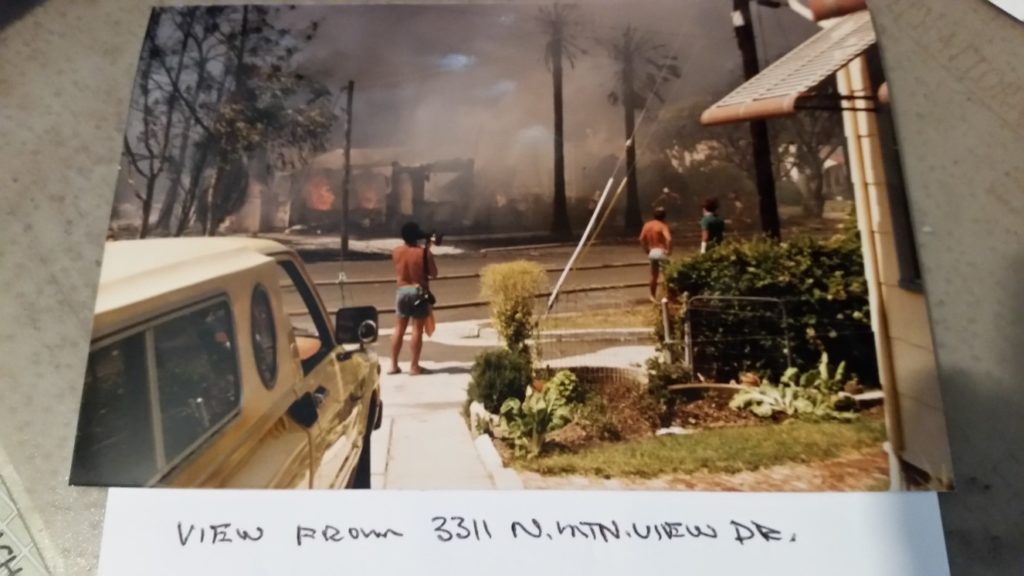
Thank you Jim Baross for this 1985 Normal Heights fire picture, taken from Jim’s driveway in the 3300 block of North Mountain View. Jim’s house was unharmed except for the door the firefighters broke down, but 75 other neighbors completely lost their home.
Categories
Fire Safe News Fire-Wise Landscaping MetroView Fire-ey Questions

Eucalyptus: Garden Friend or Fire Foe?

By Judy Beust Harrington, Co-Chair, Kensington Fire Safe

This column is your fire safe council’s effort to share answers to questions we get from community members. Send your fire-related questions to info@kensingtonfiresafe.org and we’ll do our best to find the answer!

Q: My own question this time! Lively conversation with a Master Gardener at Kensington Earth Day left me wondering, is eucalyptus the highly flammable bad-boy as we’ve been led to believe?

What’s not to love about eucalyptus trees? Wonderful shade in hot summer months? The roosts, perches, and nests they provide for raptors and other birds? The nesting material their litter supplies local alligator lizards and rat-eating gopher snakes?  Or just that these attractive, year-round green trees often smell good and have lots of medicinal uses? (1)

Too bad “some are bullies” according to local, award-winning landscaper, Greg Rubin. Their bad behavior includes crowding out often much less flammable native plants, especially with the aggressive species’ fibrous, greedy root systems that “take no prisoners.”  This includes the most prevalent blue gums, initially planted over 40,000 southern California acres starting in the mid-1800’s.  Rut Row! Now the California Invasive Plan Council (Cal-IPC ) classifies blue gums as “limited invasive“ — because their significant negative ecological impacts occur in limited areas along the California coast. (2)

Greg says he has no problem with “Eucalyptus citriodora “…beautiful, graceful, non-aggressive large form, that plays nice with our extremely delicate, complex, and non-competitive ecology.”

But back to fire safety. Bottom line: they are not native and don’t belong in our canyons. It’s all about the bark they shed.  A well-tended euc in a homeowner’s yard isn’t likely to go up in flames as fast as a wild canyon one with highly flammable detritus at the base accumulating unabated. In fact, according to a National Park Service publication on eucalyptus – “Firefighters also now realize that wildfires are almost impossible to contain in eucalyptus forests.” Want more insights? Consult the NPS Fire Management Newsletter edition on “Eucalyptus; A Complex Challenge” (3)

Moisture Matters Most

Regardless of what kind of tree or plants you put in your yard, Greg says the most important element for fire resistance is moisture. The benefit of native, drought-tolerant plants is that a little water goes a long way, and they’ll retain it better than most non-natives. Nearly two dozen properties Greg landscaped with native plants survived major area fires, without the loss of a single home!

But aside from going native, how can we increase moisture and conserve our precious water at the same time?  How about letting winter rainfall increase your ground water with a swale…big, little, mini? Why send that precious runoff into sewers to eventually muck up our rivers and waterways?  Greg cites how Dennis Mudd, creator of Calscape.org, runs swales throughout his wonderful plantings. The soil fungi in the swale moves the moisture over to his drought tolerant plantings and greatly reduces the need for watering.  That’s because you put compost in the swale and the bacteria in it will over time help break up the clay in the surrounding areas.

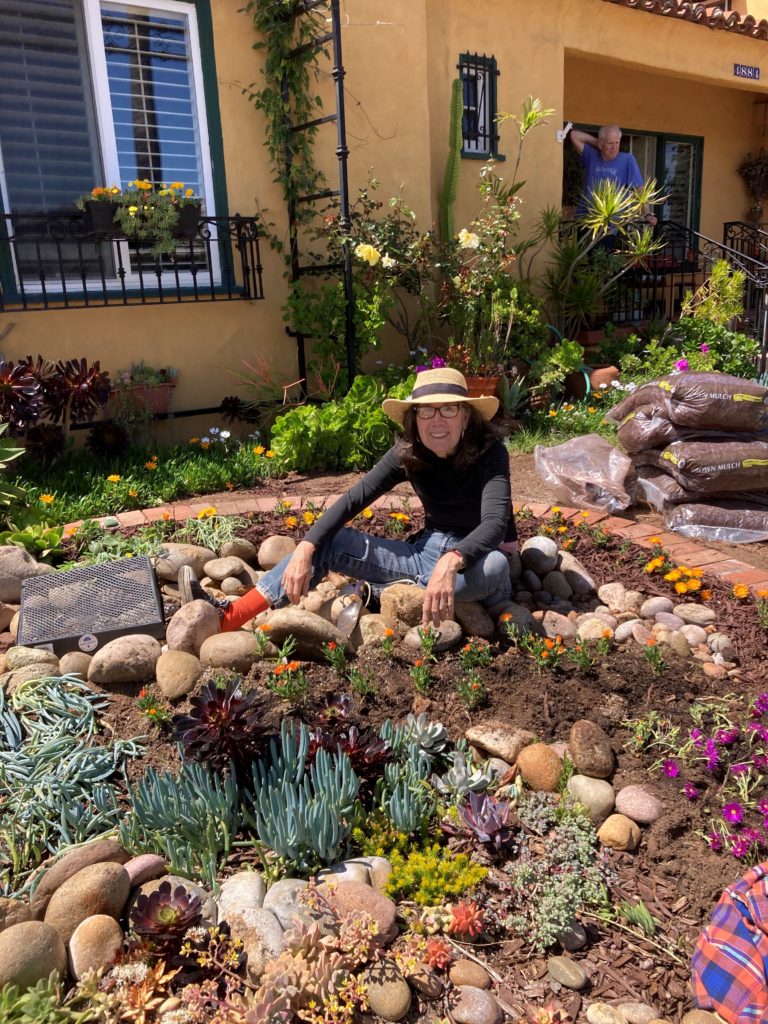
I recently put a swale in my front yard to catch the overflow from one of our rain barrels – which starts flowing in 5-10 minutes during a downpour.  Now I’m making small ones wherever there’s a low patch where I plan to garden.  YouTube has plenty of videos on how to build a swale, but you can check out what I did with pictures at kensingtonfiresafe.org. Have a swale time working on yours!

Read Judy’s post about creating a small swale in her Kensington garden.

Sitting in my swale…Judy Harrington

  1. https://nrm.dfg.ca.gov/FileHandler.ashx?DocumentID=67348
  2. https://calag.ucanr.edu/Archive/?article=ca.v070n01p39
  3. https://www.nps.gov/pore/learn/management/upload/firemanagement_fireeducation_newsletter_eucalyptus.pdf
  4. https://milliontrees.me/2014/07/21/tracking-down-the-truth-about-blue-gum-eucalyptus/
Categories
Fire Safe News Fire-Wise Landscaping MetroView Fire-ey Questions

Coif Your Canyon to Reduce Erosion and Flammability


By Judy Beust Harrington, Co-Chair, Kensington Fire Safe
Photo Credit (Above): Lucy Warren

This column is your fire safe council’s effort to share answers to questions we get from community members. Send your fire-related questions to info@kensingtonfiresafe.org and we’ll do our best to find the answer!

Q: From Loren, an Alder Circle resident: “What should I plant in my shaded, bare dirt canyon area, to reduce fire and erosion risk?”

A: There was a house on Alder they called the sliding shame… I’m told the back room went right down the canyon decades ago in a heavy rain, probably like ones we witnessed this past winter. This neighbor’s question is timely!

Lists of online drought and fire-resistant plants seem overwhelming, so I reached out to Kensington resident and UC Cooperative Extension Master Gardener, DeLayne Harmon, and she reached out to fellow MGer, Lucy Warren, a southern California sustainable landscaping expert and writer. (Check out her excellent “California Native Plants” video at: https://www.youtube.com/watch?v=6K_0mj4h548.)

Lucy’s advice? “My personal one-plant response for slopes: Baccharis ‘Pigeon Point’ mixed with at least four other species.”
“Coyote Bush” – as it is also called – is a favorite of your fire safe council! Not only is it fast-growing, drought-tolerant and slope-stabilizing, it also is said to emit a mild flame retardant when faced with a fire. And, while it prefers sun, it can grow in mostly shade too.

DeLayne clarified that Pigeon Point ground cover – Baccharis pilularis spp pilularis – is a specific coyote bush hybrid with smaller leaves that only grows to about two feet. You can often find it at City Farmers Nursery (3110 Euclid) or Hunter’s Nursery (3110 Sweetwater Road, Lemon Grove). More info at Calscape.org: https://calscape.org/Baccharis-pilularis-ssp.-pilularis-‘Pigeon-Point’-(Pigeon-Point-Coyote-Brush)?srchcr=sc5e39ba57165f9

Be a Diversity Diva

What about that “four other species” advice? Check out Lucy’s co-author and popular local landscaper, Greg Rubin’s website on the role of native landscaping in fire suppression. Greg has landscaped homes that came out relatively unharmed while nearby houses were destroyed in wildfires. His years of research for the U.S Navy established that lightly hydrated evergreen, perennial native plants assist in fire suppression as well or better than succulent plants. And diversity can help fight diseases too. More info at Greg’s CalOwn website: https://www.calown.com/nativeEcology_fireSafety.html
The local chapter of the California Native Plant Society (https://www.cnpssd.org/ ) has a great pamphlet which lists native plants for area landscapes. And you can narrow info down to your specific needs at gardenplanner.calscape.org.

Plant water!

Another way you might increase your canyon’s erosion and fire resistance is to capture some of the mountains of water that run off your house, with rain barrels and “swales” to safely catch the barrel’s overflow during our rainy season. Swales are basically flat ditches or gutters, which can be filled with rocks, compost, and plants to safely increase your ground water and keep established plants healthy. They can slow a fire’s spread toward your house and keep your trees alive if the day ever comes when we’re prohibited from using scarce water for gardens. Much swale how-to info is available online or search permaculturenew.org for “mini-swales in an urban backyard.” (https://www.permaculturenews.org/2016/01/11/mini-swales-in-an-urban-backyard/).

Bottom line for fire and erosion resistance: no to any dry woody stems, like ice plant, no to invasives like Pampas grass or leaving the ground bare. Yes to harvesting barrels of rainfall to support oodles of attractive native plant diversity! Matchy-matchy is out in jewelry and gardens!